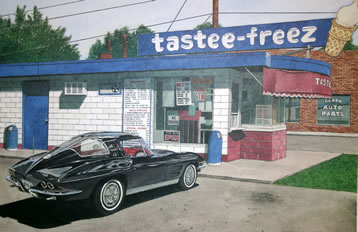
| The line of teen-agers stretched from the outside doors of the home all the way down the block to the Tasty Freeze. It was a late spring afternoon in the small West Virginia town, and some kids were now carrying the coats they'd had on when they'd first gotten into the line. |
 |
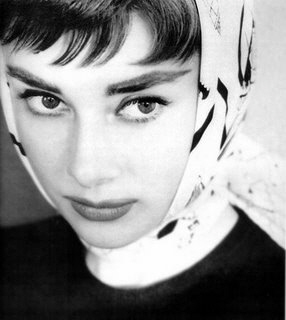
| All were dressed as if going to church. It was the 1950's, and the girls wore dresses - every single one of them. None had chosen to wear those horrible, scratchy full net underskirts of the era, but most wore white gloves and hats. Some girls had head scarves tied in the manner of Bridgette Bardot. Tres chic. Most of the hats, however, were dreadful. They had obviously been borrowed from Mom and sat incongruously perched on top of ponytails and pageboy hairdos, making the girls who wore them feel both uncomfortable and ridiculous. |
|
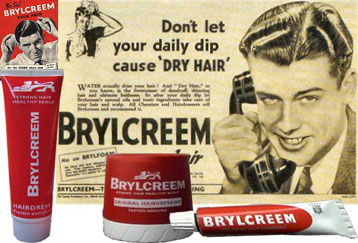
| The boys had on slacks with too much material flapping around their ankles. Their hair was slicked back with BrylCreem or some other gloop into the style called a "D.A." Their restless hands popped in and out of their pockets. They were trying very hard to stay "Cool, Daddy-o." But those big puppy-like hands, too big for their growing bodies, gave them away. They didn't want to be here. This was a perfect day for fishing, or for shooting some hoops! |
|
But here they were, standing in the line with kids they didn't know, looking around for a familiar face. Here and there, you could see shifts in the line as boys and girls dropped out and joined friends ahead or behind where they had stood. These were kids who didn't live in the town, but who had driven many miles that same morning just to get here when the doors of the home opened. I was one of those kids. Not old enough to drive, I had been given a ride by a neighbor, a senior, no less. We joined the line together, but he soon spotted some male friends clustered ahead of us and waved to them. |
| I waved, too. I knew those guys and the exact date when we'd all parted company, nine months earlier. They motioned for him to join them. He turned to me. |
| "Do you remember where the car is parked?" he asked me, the dumb little freshman. |
"Yes," I lied. And then he was gone.
|
| |
| I watched as he made his way up the line, and observed the reunion. It was not the usual shoulder-punching, back-slapping greetings of young males. They spoke quietly, as befitted the occasion. As the line began to move forward, I, too, spotted friends my own age, and as they were behind me, I motioned them forward. Our reunion was also subdued. Squeals, laughter, the usual girl talk, were all inappropriate, for this home we would soon enter was a funeral home. |
| We had all come to say goobye to West. |
| That's what we, the out-of-towners, had called her-- West. |
|
|
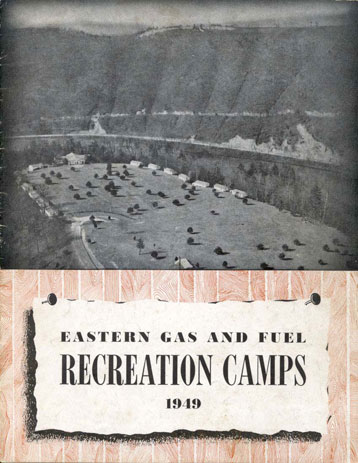
| We'd last seen her, and each other, on the last day of Camp the previous summer. West, a senior counselor, had barked orders at us campers and later, as junior counselors, at Camp Thomas E. Lightfoot. We were all children of employees of Eastern Gas and Fuel, a company based in Boston and Pittsburgh. |
|
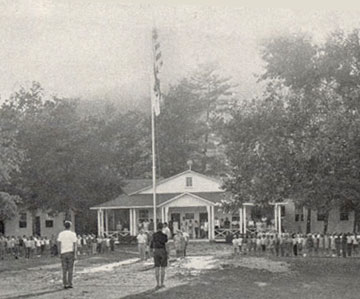
This company had purchased a large tract of land on the Greenbrier River near Hinton, West Virginia. For seven dollars a head, employees could send their children to the camp for two weeks of swimming, sports, crafts, and invaluable lessons in how to take care of themselves. The camp site ended in a peninsula jutting southward into a bend of the Greenbrier River. The girls cabins were on the east coast, and the boys were housed on the west coast, and the dining hall was on the tip. The dining hall was also the community center, activity center on rainy days, and it housed the Craft Shop in its basement. It wasn't until I became a junior counselor that I learned that it was also the after-Taps hang-out spot and it held a hidden juke-box. Only we teenagers had any energy left at night for dancing.
Campers and counselors alike had very tight schedules from the first notes of Reveille to the last note of Taps, leaving little time for planning the next day's activities with the campers. We'd all pop out of our bunks and, before leaving the cabin, make up our beds with folded corners and smooth blankets. Getting it right was hard for a seven-year-old, so the older girls with the top bunks usually helped out on the first day or two. Once the bed was made, we'd grab our toiletry bags and go down the path that ran in front of the cabins to the girls' shower house beside the dining hall. Some of us would drop off the path to first visit the glorified outhouses we like to call the "Little Girls' Doom" because the local animals loved the warmth of the light bulbs that guided us there at night. |
 |
| The other campers would trudge down to the showers, needing to get back to dress before the huge bell by the dining hall summoned us to the morning flag raising. This was the standard military ceremony. The flag was presented, still in its triangular shape from the after-dinner flag lowering of the night before. Two columns of teenage boys, dressed in shorts and T-shirts, respectfully unfolded the flag and raised it with the dignity of the Marine Corps. It was great theater, and no one dared to miss it. |
 |
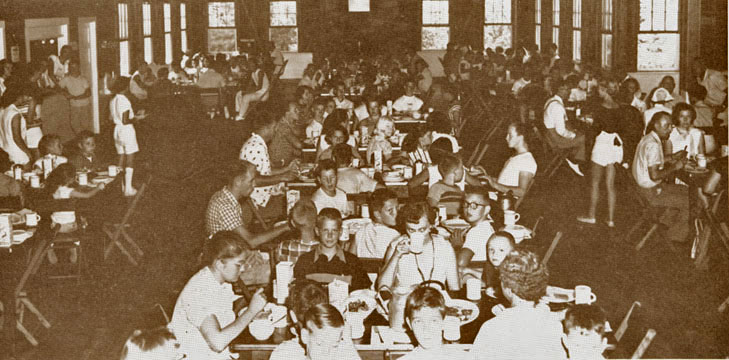
| Then we'd file into the dining room to sit at our assigned tables. As a J.C., I sat at the foot of the table, opposite the senior counselor. Six campers filled in the side chairs. I myself had placed every utensil, napkin and piece of crockery on that table, and was responsible for another twenty such tables as my share of that work. Once the tables had been cleared by the campers, I would wipe them and set them again for the next meal. We also snapped peas, strung beans, and shucked corn for a total of three hundred people or so. |
|
| In our so-called spare time we rehearsed skits and practiced dances, patriotic programs and such, for either the evening vespers or for the huge campfire meetings where we all, campers and counselors, entertained each other before Taps. It was, I now suppose, a lot like working for Club Med. The locale, however, had no palm trees. It did have skunks, bats, black racer and copperhead snakes, But we were children who lived in coal-mining communities, tucked away in narrow valleys. Encounters with such creatures was daily fare, ho hum--old hat. You saw a copperhead? Poor baby. Get on to your morning activity. These activities were elective. Senior counselors offered to teach whatever they could do best, so the choices changed from summer to summer with each new staff. We would choose a couple of classes in Indian lore, first aid, knot tying, camp craft--that sort of thing. After lunch, campers were divided into three groups and rotated through three afternoon activities. One third of the campers went to the dining hall basement for Crafts, the second group to the Sports Field to do games not necessarily of their choosing. I still don't get the point of tetherball. |
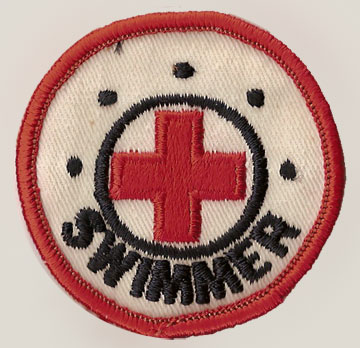
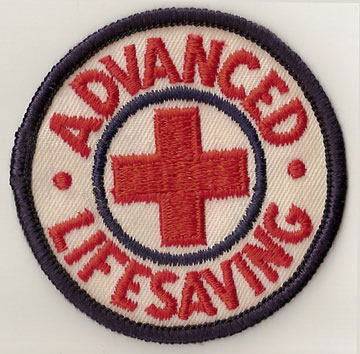
| And so, when it came time to get my junior life-saving badge, and I knew that West was the only teacher, I quaked in my rubber tongs. The badge was required if I hoped to be a junior counselor the next summer. I signed up for the course as if I were signing my own death warrant. Then I discovered that I had been the only girl to do so. There we were at the first class, five huge football jocks and tall, skinny, landlubbing me. I weighed in at about one-hundred pounds after a steak dinner in those days. Sigh. Every victim needs a lifesaver. Every would-be life-saver needs a victim, or at least someone pretending to be a victim. Getting the junior life-saving badge required having a partner, and it was West who determined the pairing. She rubbed one hand over her short, brown, straight hair as she looked us over. Pointing at the smallest of the titans, she then pointed at me, and his face fell. He knew I couldn't swim; they all did. But West had spoken, sort of, and that was that. She blew her whistle, and the boys were in the river. I was just up that well-known creek without . . . well, you know. |
| I got to know her better the next year when I got to be the J.C. for the morning Camp Craft classes. I was as comfortable in the woods as my sister was in the water. Also, working in Camp Craft meant that for one or two nights per camp session, I would actually get to stay overnight in the woods well below the boys cabins. Two whole days of living in tents and eating food cooked over an open fire or baked in a hole in the ground. Yum. Imagine my surprise on the morning of my first campover, as I stood buck naked in my cabin preparing to dress for the outing, when I heard a man's voice yelling, "Cobb!" I grabbed a robe and turned to see West, dressed in jeans and a plaid hunting shirt. |
| "What the hell do you think you're doing? We're late!" |
| WE? We are late? Now I knew that West also loved the woods. The kids were great, the weather fine, and the long hike was fun, even with the loads on our backs. It was a lovely Friday afternoon when we reached the campout site, and I began to unpack the food which I had planned for our evening meal. A cute little pig-tailed girl, whose freckled face was showing some mild alarm, tugged at my shirt sleeve. |
| "Chicken!" said she. "We're having chicken for dinner?" |
| "Yeah," I retorted, " Don't people in southern Pennsylvania eat chicken?" |
| "Not," says the Imp from Hell, "if it's Friday and they are Catholic!" |
| "Cobb," says West with a sardonic smile, "Looks like someone's going to hike back for some fish fillets. Guess who." |
| |
| More memories of West came rushing at me as we neared the viewing room. I recalled West sitting by the campfire after the campers, full of Kool-Aid and S'Mores, were all in their tents for the night. I could see her, sitting on her cot next to the fire, shoulders hunched, elbows resting on her knees, as she told us stories about the old days at the camp. She looked and talked like a man, a truck driver, perhaps. She even smoked little Cuban cigarellos. They were long, black, and tightly rolled. She had loved them, and they had probably killed her. |
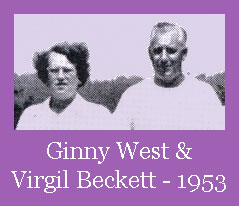
| It was my time now to say goodbye. I looked down into the coffin. At age fourteen, I'd been lucky enough to never before attend a viewing. As I looked at the body, I was shocked to see that I was at the wrong funeral. This person bore no resemblance to West. The brown hair was short, but it was curled around a rouged face. She wore lipstick, and there was lace at her throat. Lace, for cryin' out loud. Then I thought of the town kids in line and realized that they had been her students at the local high school. To them, she was Miss West, history teacher, the one whose parents had given her that funny name. The poor woman was Virginia West from West Virginia, not my friend from summer camp. I searched her face for a hint of familiarity, and found it at last in the slightly sardonic smile. There she was. Now I could say goodbye. Leaning over her coffin, I bent down and whispered to her, "West! What the hell do you think you're doing? Come back!" |
| |
| Danna Paglino - March 2003 |
| |